


How to Create a Home Inventory Before You Need to File a Claim
Most homeowners find out they needed a home inventory after the worst moment of their lives. A fire. A break-in. A flood. Here is how to create one before it is too late.
Most homeowners find out they needed a home inventory after the worst moment of their lives. A fire. A break-in. A flood. When you are already dealing with the emotional weight of a major loss, the last thing you want to do is try to remember every single item you owned from memory while an insurance adjuster waits for a list.
A home inventory solves that problem before it happens. It is one of the simplest and most valuable things you can do as a homeowner or renter, and most people never do it.
Here is exactly how to create one, what to include, and how to store it so it is actually accessible when you need it.
What Is a Home Inventory and Why Does It Matter?
A home inventory is a documented record of everything you own. It typically includes a description of each item, its approximate value, the purchase date if you have it, and ideally a photo or video of the item.
When you file a homeowners or renters insurance claim after a theft, fire, or natural disaster, your insurer will ask you to provide a list of everything that was lost or damaged along with its estimated value. Without a home inventory, you are doing this from memory under stress, often weeks or months after the event.
Most people significantly underestimate how much they own. The average American household has between $20,000 and $50,000 worth of personal property. Replacing it all after a major loss without documentation means relying on your memory alone, and most people remember far less than they think.
A well-documented home inventory protects you in two important ways. It makes sure you have enough coverage before a claim happens. And it makes the claims process significantly faster and less stressful after one does.
Step 1: Walk Through Every Room and Document What You Own
Start at the front door and work your way through your home room by room. Do not try to do the whole house at once. Pick one room, spend 20 to 30 minutes on it, and move to the next one another day. Done in pieces, a complete home inventory takes most people two to three hours total.
For each room, document the following categories:
Electronics. Television sets, computers, laptops, tablets, phones, gaming consoles, cameras, speakers, and any accessories. These are often the highest-value items in any room and among the most commonly stolen.
Furniture. Sofas, beds, dressers, tables, desks, chairs, and any other large pieces. Include the brand if you remember it and the approximate purchase price.
Clothing and accessories. This category is consistently underestimated. Walk through your closet and estimate the replacement cost of your wardrobe, shoes, bags, belts, and accessories as a group rather than item by item.
Appliances. Refrigerator, washer, dryer, dishwasher, microwave, coffee maker, and any other kitchen or household appliances.
Jewelry and valuables. This is the category that deserves the most attention. High-value jewelry, watches, collectibles, artwork, and musical instruments should each be listed individually with an estimated or appraised value. Note that standard homeowners policies often have sublimits on jewelry coverage. If you own valuable pieces, ask your agent whether you need a separate rider.
Kitchen and dining. Cookware, dishes, glasses, silverware, and small appliances.
Tools and outdoor equipment. Power tools, hand tools, lawn equipment, bicycles, sporting goods, and anything else stored in a garage or shed.
Step 2: Take Photos or Video of Everything
Written documentation is valuable. Photos and video are even better. After you document each room in writing, walk through with your phone and record a slow video of every room, opening closets and cabinets as you go. Narrate what you are seeing as you record.
This takes about five minutes per room and creates a visual record that is far more compelling to an insurance adjuster than a written list alone. When you can show a video of your fully stocked kitchen, organized closet, or garage full of tools, there is no ambiguity about what you owned.
For high-value items like jewelry, art, or collectibles, take individual close-up photos in good lighting and include any documentation you have such as receipts, appraisals, or certificates of authenticity.
Step 3: Record the Details That Matter
For each significant item, try to capture the following information. You do not need all of it for every item, but the more you have, the stronger your claim will be.
Description of the item including brand, model, and color. Approximate purchase date. Purchase price or current estimated replacement value. Serial number if available, especially for electronics and appliances. Where you purchased it. Any receipts, warranties, or appraisals you can attach.
Step 4: Store Your Inventory Somewhere Accessible
A home inventory stored on your laptop is useless if your laptop burns in a house fire. Store your inventory in at least two places, and at least one of them should be off-site or in the cloud.
Good options for storage: A cloud-based service like Google Drive, iCloud, or Dropbox. Your insurance company's app if they offer a home inventory tool. An external hard drive kept at a family member's home. A printed copy in a fireproof safe or safe deposit box.
If you recorded video of your home, upload it to a private YouTube video, your cloud storage, or email it to yourself so it is stored on a server separate from your home.
Step 5: Update It When Things Change
A home inventory is not a one-time project. It needs to be updated whenever you make significant purchases or acquisitions. A new television, a new piece of jewelry, a new appliance, or a major home renovation all change the value of your personal property.
Set a reminder once a year, perhaps when your homeowners policy renews, to walk through your home and update your inventory. It takes far less time after the first one is complete.
Free Home Inventory Checklist
Use the room-by-room checklist below to get started today.
Living Room Television and entertainment equipment, furniture, artwork and decor, gaming consoles, books and media, rugs and window treatments
Kitchen Appliances, cookware and bakeware, dishes and glassware, small electronics, silverware and utensils
Bedrooms Clothing and shoes, accessories and jewelry, furniture, electronics, bedding
Bathrooms Grooming equipment, medical devices and equipment
Home Office Computers and monitors, printers and peripherals, office furniture, files and documents of value
Garage and Outdoor Power tools, hand tools, lawn equipment, bicycles and sports equipment, outdoor furniture
Other Valuables Jewelry and watches (itemize individually), artwork and collectibles, musical instruments, firearms, antiques
Does Your Insurance Cover Everything You Own?
Once you have completed your home inventory, compare the total estimated value of your belongings to the personal property coverage on your homeowners or renters insurance policy. Many people discover they are significantly underinsured after going through this process.
If the replacement cost of your belongings exceeds your coverage limit, or if you own high-value items that may require a separate rider, call us. We will review your current policy and make sure you are properly protected.
Frequently Asked Questions
Q: How long does it take to create a home inventory? Most homeowners can complete a thorough inventory in two to three hours spread across several sessions. Doing one room at a time makes it manageable.
Q: Do I need receipts for everything? No. Receipts help but are not required. Your insurer will work with your estimates and photos. For high-value items, an independent appraisal is more useful than a receipt.
Q: What if I am a renter? Do I still need a home inventory? Yes. Renters insurance covers your personal belongings and a home inventory helps you document what those are. The process is exactly the same as for homeowners.
Q: Can I use an app for my home inventory? Yes. Several apps are designed specifically for home inventories including Encircle, Sortly, and the MyHome app from the Insurance Information Institute. Many insurance companies also have their own inventory tools built into their mobile apps.
Q: What happens if I do not have a home inventory when I file a claim? You can still file a claim without one. Your insurer will work with you to reconstruct your list. But the process takes significantly longer, the amounts may be lower than what you actually lost, and the burden of proof falls entirely on your memory.
Get a Free Insurance Review in Corona, CA
Ibrahim Insurance Agency serves homeowners and renters throughout Corona, Riverside, Norco, Ontario, Chino, Eastvale, Jurupa Valley, and the greater Inland Empire. As your local Allstate agency, we review your coverage, help you understand what you actually have, and make sure it matches what you actually own.
DM us the word CHECKLIST for your free printable home inventory checklist.
Call or text us: (951) 256-9648Visit us: 1451 Rimpau Ave Ste 101, Corona, CA 92879Hours: Monday to Friday, 8:30am to 5pmHablamos Espanol
Get Your Free Insurance Review
Ibrahim Insurance Agency Inc. | CA License 60037

How to Compare Auto Insurance Quotes in California Without Losing Important Coverage
Shopping for auto insurance in California is easy. Finding the best price without giving up the coverage you actually need is harder. Here is exactly how to do both.
The cheapest auto insurance quote is not always the best one. Here is what to look for before you switch.
Shopping for auto insurance in California is easier than ever. You can get a quote online in minutes, compare prices across dozens of carriers, and find a policy that costs significantly less than what you are currently paying. The process feels straightforward.
But here is what most people do not realize until after an accident: the cheapest quote is usually cheap for a reason. Lower limits, higher deductibles, missing coverages, and exclusions buried in the fine print all contribute to a lower monthly payment. And all of them can leave you financially exposed when you actually need your insurance to work.
This guide walks you through exactly how to compare auto insurance quotes in California the right way, so you get the best price without giving up the protection you actually need.
Step 1: Understand What California Requires vs What You Actually Need
California law requires every driver to carry minimum liability insurance:
$15,000 in bodily injury liability per person, $30,000 per accident, and $5,000 in property damage liability per accident.
These are the legal minimums. They are not the recommended coverage levels. A single serious accident in California can easily generate claims that exceed these limits by hundreds of thousands of dollars. If your policy only covers the minimums and a judgment comes in above those limits, the rest comes directly out of your own pocket.
When comparing quotes, do not just compare prices. Compare prices at the same coverage levels. A quote with $15,000 in liability will always be cheaper than a quote with $100,000. But they are not the same product.
Step 2: Compare the Same Coverage Across Every Quote
This is where most people go wrong. They get three quotes, see different prices, and assume the cheapest one is the best deal. But if the quotes have different coverage levels, deductibles, and included coverages, you are not actually comparing the same thing.
Before you start shopping, decide on your coverage levels. Here is a reasonable starting point for most California drivers:
Liability — $100,000 per person, $300,000 per accident, $100,000 property damage. Uninsured and underinsured motorist — $100,000 per person, $300,000 per accident. Collision — with a $500 or $1,000 deductible. Comprehensive — with a $500 or $1,000 deductible.
Then get every quote at those exact same levels. Now you are comparing apples to apples and the price differences you see are actual savings, not just different products at different coverage amounts.
Step 3: Watch for These Common Coverage Gaps
No uninsured motorist coverage. California has one of the highest rates of uninsured drivers in the country. If an uninsured driver hits you, your own insurance needs to cover your injuries and damages. Leaving this coverage off your policy to save money is one of the most common and most costly mistakes California drivers make.
Low liability limits. The state minimums are $15,000 per person. In a serious accident involving medical bills, lost wages, and legal fees, $15,000 disappears in an afternoon. If you cause an accident and your limits are not enough to cover the damages, you are personally responsible for the rest.
Actual cash value instead of replacement cost. When your car is totaled, actual cash value pays what your car was worth the day before the accident. Replacement cost pays what it would cost to replace it with a comparable vehicle today. For newer cars, the difference can be thousands of dollars.
No rental car coverage. If your car is in the shop after a covered claim, rental car coverage pays for your transportation. It is a small add-on that most people only miss when they need it.
No roadside assistance. Cheap policies often strip out roadside assistance. If you have ever been stranded with a flat tire or a dead battery, you know how valuable this coverage is.
Step 4: Look Beyond the Premium
The monthly premium is one number. But auto insurance involves several other factors that affect the real value of a policy.
The deductible. A lower premium often comes with a higher deductible. If you are saving $30 per month but your deductible is $1,000 higher, you need to file a claim and pay that deductible only once to wipe out a full three years of savings.
The carrier's claims reputation. A policy is only as good as the company's willingness to pay claims fairly and efficiently. Some carriers are significantly better than others when it comes to claims handling. Your agent can tell you which carriers have the strongest reputations in California.
Discounts you may be missing. Most carriers offer discounts for bundling home and auto, maintaining a clean driving record, low annual mileage, good grades for student drivers, anti-theft devices, and paperless billing. Make sure every quote reflects all the discounts you qualify for.
Step 5: Work With a Local Independent Agent
Shopping for auto insurance on your own means comparing one carrier at a time or using a price comparison website that may not show all available options. Working with an independent insurance agent means someone who knows the California market is comparing rates from multiple carriers on your behalf and explaining the differences so you can make an informed decision.
At Ibrahim Insurance Agency in Corona, we review your current policy, ask the right questions about how you use your vehicle and what coverage you need, and find the best combination of price and protection available for your specific situation.
We are not tied to any single carrier. We work for you.
What Does Good Auto Insurance Coverage Look Like in California?
Here is a simple breakdown of what adequate coverage looks like for most California drivers versus what a stripped-down minimum policy looks like:
Minimum policy (legal requirement only) Bodily injury liability: $15,000 per person / $30,000 per accident Property damage liability: $5,000 No collision, no comprehensive, no uninsured motorist
Recommended coverage for most California drivers Bodily injury liability: $100,000 per person / $300,000 per accident Property damage liability: $100,000 Uninsured/underinsured motorist: $100,000 / $300,000 Collision: included with $500 deductible Comprehensive: included with $500 deductible Rental car reimbursement: included Roadside assistance: included
The price difference between these two policies for a typical California driver is often $50 to $100 per month. But the difference in protection is enormous. One serious accident with a minimum policy can cost you hundreds of thousands of dollars. The same accident with adequate coverage costs you your deductible.
How Bundling Can Lower Your Auto Insurance Rate
One of the most effective ways to reduce your auto insurance premium in California without sacrificing coverage is to bundle your auto and home or renters insurance with the same carrier.
Most major carriers offer a discount of 10 to 25 percent when you bundle policies. On a $150 per month auto policy, a 15 percent bundle discount saves $270 per year. That is real money, and you get it without reducing your coverage at all.
If you are currently carrying your auto and home insurance with different companies, ask your agent to run a bundled quote. The savings are often more significant than people expect.
Frequently Asked Questions
Q: How often should I shop for auto insurance quotes in California? Reviewing your auto insurance at least once per year is a good habit. Rates change, your circumstances change, and new discounts may become available. Comparing quotes at renewal time ensures you are not paying more than you need to.
Q: Does comparing quotes affect my credit score? Soft credit inquiries used for insurance quoting do not affect your credit score the way hard inquiries for loans do. You can compare quotes freely without worrying about your credit.
Q: Can I switch auto insurance carriers mid-policy? Yes. You can switch carriers at any time. Most policies can be cancelled with a short notice period and you are entitled to a prorated refund of any unused premium. Your new policy should start on the same day your old one ends to avoid any gap in coverage.
Q: What is the best auto insurance company in California? There is no single best carrier for every driver. The right company depends on your driving record, the vehicles you drive, where you live, and what coverage you need. That is why working with an independent agent who can compare multiple carriers is more effective than choosing one company on your own.
Q: How do I know if I am currently underinsured? The clearest sign is having only state minimum liability coverage on a policy you have not reviewed in more than a year. Call us and we will review your current policy in ten minutes and tell you exactly where you stand.
Get a Free Auto Insurance Quote in Corona, CA
Ibrahim Insurance Agency serves drivers throughout Corona, Riverside, Norco, Ontario, Chino, Eastvale, Jurupa Valley, and the greater Inland Empire. As your local Allstate agency, we compare options across multiple carriers and find the right coverage at the most competitive price for your specific situation.
Call or text us: (951) 256-9648Visit us: 1451 Rimpau Ave Ste 101, Corona, CA 92879Hours: Monday to Friday, 8:30am to 5pmHablamos Espanol
Get Your Free Auto Insurance Quote
Ibrahim Insurance Agency Inc. | CA License 6003799

What Is Umbrella Insurance and Do You Need It in California?
Most people assume umbrella insurance is for wealthy people. It is not. A $1 million policy costs most California families less than $25 a month. Here is exactly how it works and whether you need it.
For less than $25 a month, you could have an extra million dollars in liability protection. Here is how it works.
Most people have never heard of umbrella insurance. And the ones who have usually assume it is something only wealthy people need. Both of those things are wrong.
Umbrella insurance is one of the most underrated and misunderstood types of coverage available. It is also one of the most affordable. For a typical California family, an extra million dollars in liability protection can cost as little as $15 to $25 per month. That is less than most streaming subscriptions.
Here is everything you need to know about umbrella insurance in California, who needs it, and whether it makes sense for your situation.
What Is Umbrella Insurance?
Umbrella insurance is a personal liability policy that provides additional coverage beyond the limits of your existing home, auto, and renters insurance policies. It kicks in when those underlying policies run out.
Think of it this way. Your auto insurance might include $300,000 in liability coverage. Your homeowners insurance might include $300,000 in personal liability. Those limits sound like a lot until you are involved in a serious accident and realize how quickly medical bills, legal fees, and lost wage claims can exceed them.
Umbrella insurance sits on top of your existing policies and covers the gap. It does not replace your home or auto insurance. It extends them.
A Real Example of How It Works
You cause a serious car accident on the 91 freeway in Corona. The other driver sustains a back injury requiring surgery. Their medical bills total $180,000. They also miss four months of work and file a claim for lost wages. Their attorney adds pain and suffering damages. The total claim reaches $420,000.
Your auto insurance covers the first $300,000. Without umbrella insurance, you are personally responsible for the remaining $120,000. Your savings account, your home equity, and your future wages are all at risk.
With a $1 million umbrella policy, the remaining $120,000 is covered completely. Your savings stay intact. Your home stays protected.
That scenario is not extreme. It is the kind of claim that happens on California freeways every week.
What Does Umbrella Insurance Cover in California?
Bodily injury liability. If you are held responsible for injuring someone in a car accident, a slip and fall on your property, or any other incident, umbrella insurance covers costs that exceed your underlying policy limits.
Property damage liability. If you or a family member accidentally damages someone else's property and the cost exceeds your home or auto coverage, umbrella insurance covers the difference.
Personal liability. Umbrella policies also cover certain situations that your home or auto policies may not cover at all, including libel, slander, false arrest, and invasion of privacy claims.
Legal defense costs. Even if a lawsuit against you is ultimately dismissed, defending yourself costs money. Umbrella insurance covers legal defense costs in addition to any settlements or judgments.
Incidents away from home. Your umbrella policy follows you. It covers incidents at someone else's home, while you are traveling, or anywhere else in the world, not just on your property.
What Umbrella Insurance Does NOT Cover
Umbrella insurance is not a catch-all. It does not cover your own injuries or damage to your own property. It does not cover business-related liability, which requires a commercial umbrella policy. It does not cover intentional acts or criminal behavior. And it does not cover workers compensation claims if you employ household workers.
For most people, these exclusions are not a concern. Umbrella insurance is designed to protect you from the financial consequences of accidents and legal claims made by others against you.
How Much Does Umbrella Insurance Cost in California?
This is where most people are surprised. Umbrella insurance is significantly more affordable than most people expect.
$1 million in coverage — $150 to $300 per year $2 million in coverage — $225 to $375 per year $3 million in coverage — $300 to $450 per year $5 million in coverage — $400 to $600 per year
A $1 million umbrella policy costs most California families between $12 and $25 per month. To put that in perspective, that is less than a tank of gas, less than a gym membership, and less than most people spend on coffee in a week.
The reason umbrella insurance is so affordable is that it only pays out after your underlying policies are exhausted. Insurers are not paying the first dollar of most claims, which keeps the cost low.
Who Needs Umbrella Insurance in California?
The honest answer is that most homeowners and drivers in California can benefit from umbrella insurance. You should take it seriously if any of the following apply to you.
You own a home. Your home is likely your most valuable asset. A judgment against you in a lawsuit can put your home equity at risk. Umbrella insurance protects it.
You have a teenage driver on your policy. Teen drivers are statistically more likely to cause serious accidents than any other age group. The liability exposure from a teen driver alone often justifies an umbrella policy.
You have a pool, trampoline, or other attractive nuisance. These features increase your liability exposure significantly, especially when neighbors and their children are around.
You own a dog. Dog bite liability claims in California average over $50,000. If your dog injures someone, your homeowners liability coverage may not be enough. Umbrella insurance provides an additional layer of protection.
You drive frequently. More time on California roads means more exposure to accidents. If you have a long commute or regularly drive on freeways like the 91 or 15 near Corona, umbrella insurance is worth considering.
You have savings, investments, or other assets. If you have assets worth protecting beyond your paycheck, umbrella insurance is one of the most cost-effective ways to protect them.
You coach, volunteer, or serve on a board. These activities can expose you to personal liability in ways most people do not anticipate.
How Much Umbrella Coverage Do You Need?
A common starting point is to carry umbrella coverage equal to your net worth. If your home equity, savings, and investments total $500,000, a $1 million umbrella policy gives you solid protection with a meaningful buffer.
If you have significant assets or a higher-risk lifestyle, $2 million or more may be appropriate. The incremental cost of additional coverage is small enough that erring on the side of more coverage usually makes financial sense.
At Ibrahim Insurance Agency, we help you calculate the right amount based on your specific situation rather than guessing.
Umbrella Insurance and Your Existing Policies
Before an umbrella policy kicks in, most insurers require you to carry minimum levels of underlying liability coverage on your home and auto policies.
Typically this means at least $300,000 in personal liability on your homeowners or renters insurance and at least $250,000 per person and $500,000 per accident in bodily injury liability on your auto policy.
If your current policies have lower limits than these minimums, you may need to increase them before adding an umbrella policy. Your insurance agent can review your current coverage and make sure everything is properly aligned so there are no gaps between your underlying policies and your umbrella.
Frequently Asked Questions
Q: Can renters get umbrella insurance? Yes. Umbrella insurance works on top of renters insurance just as it does with homeowners insurance. You do not need to own a home to benefit from the extra liability protection.
Q: Does umbrella insurance cover incidents involving my business? No. Personal umbrella insurance covers personal liability. If you own a business and need additional liability protection beyond your commercial policies, you need a commercial umbrella policy. Talk to your agent about both options.
Q: Does umbrella insurance cover me in other states? Yes. Personal umbrella insurance typically provides coverage throughout the United States and in many international locations as well.
Q: How quickly can I get umbrella insurance? In most cases, same-day coverage is available once your underlying policies meet the required minimum limits. Call Ibrahim Insurance Agency and we can often have your umbrella policy in place the same business day.
Q: Is umbrella insurance worth it if I do not have many assets? Even without significant assets today, a large judgment against you can garnish your future wages for years. Umbrella insurance protects your earning potential, not just what you own right now.
The Bottom Line
Umbrella insurance is one of the smartest financial decisions a California homeowner or driver can make. For less than the cost of a streaming service, you get an extra million dollars in liability protection that covers the scenarios your home and auto policies are not designed to handle.
Most people who buy umbrella insurance do so after hearing about someone they know who faced a lawsuit without enough coverage. Do not wait for that moment. Get covered before something happens.
Get a Free Umbrella Insurance Quote in Corona, CA
Ibrahim Insurance Agency serves families and individuals throughout Corona, Riverside, Norco, Ontario, Chino, Eastvale, Jurupa Valley, and the greater Inland Empire. As your local Allstate agency, we take the time to review your complete insurance picture and make sure everything works together the way it should.
Call or text us: (951) 256-9648Visit us: 1451 Rimpau Ave Ste 101, Corona, CA 92879Hours: Monday to Friday, 8:30am to 5pmHablamos Espanol
Get Your Free Umbrella Insurance Quote
Ibrahim Insurance Agency Inc. | CA License 600379

How Much Does General Liability Insurance Cost for Small Businesses in California?
Most small business owners in California assume general liability insurance is expensive. For most businesses it costs less per month than a cell phone bill. Here is the full breakdown by industry.
It is more affordable than most business owners think. Here is the breakdown by industry.
When small business owners in California hear the words general liability insurance, many assume it is expensive, complicated, or only for larger companies. The reality is that for most small businesses, general liability insurance costs less per month than a cell phone bill. And unlike a cell phone, one claim without it can cost you everything you have built.
This post breaks down exactly what general liability insurance costs for small businesses in California, what affects your rate, and how to make sure you are not overpaying.
What Is General Liability Insurance and Why Does It Matter?
General liability insurance protects your business from third-party claims of bodily injury, property damage, and advertising injury. If a customer slips and falls in your store, if your work accidentally damages a client's property, or if someone sues your business over something you advertised, general liability covers your legal defense costs, settlements, and judgments.
Without it, every one of those situations becomes a personal financial liability. And in California, one of the most litigious states in the country, the risk is real regardless of how small your business is.
General Liability Insurance Cost in California — By Industry
The single biggest factor in what you will pay for general liability insurance is your industry. Here is a breakdown of typical annual premiums for small businesses in California:
Consultant or freelancer — $400 to $800 per year
Home-based business — $300 to $700 per year
Marketing or advertising agency — $500 to $1,200 per year
Real estate agent — $600 to $1,400 per year
Retail store — $600 to $1,500 per year
Hair salon or barbershop — $700 to $1,500 per year
Cleaning or janitorial service — $800 to $1,800 per year
Landscaping or lawn care — $800 to $2,000 per year
Handyman or general contractor — $1,000 to $2,500 per year
Plumber or electrician — $1,200 to $3,000 per year
Restaurant or food service — $1,000 to $3,000 per year
Construction contractor — $1,500 to $5,000 per year
To put this in perspective: a freelance consultant paying $600 per year for general liability insurance is spending $50 per month for coverage that could protect them from a six-figure lawsuit. A restaurant owner paying $2,000 per year is spending $167 per month to cover a business that could face a claim every single week from customer injuries alone.
What Affects the Cost of General Liability Insurance?
Your industry is the starting point but several other factors determine your exact premium.
Business size and revenue. Higher revenue generally means more business activity, more customer interactions, and higher claim risk. Insurers use your annual revenue as a proxy for exposure when calculating your rate.
Number of employees. More employees means more people whose actions could result in a claim against your business.
Business location. Where your business operates matters. Urban areas with higher foot traffic and higher costs of living typically have higher premiums. Your specific address in California can affect your rate.
Claims history. If your business has had prior liability claims, expect to pay more. A clean claims history is one of the most effective ways to keep your premium low over time.
Coverage limits. Most small businesses carry a $1 million per occurrence and $2 million aggregate policy. Higher limits cost more. Lower limits cost less but leave you more exposed in a serious claim.
Deductible. Some general liability policies include a deductible. Choosing a higher deductible lowers your premium but increases what you pay out of pocket when a claim occurs.
Type of work performed. Even within the same industry, what you actually do day to day affects your rate. A contractor who does roofing pays more than one who does interior painting because the risk profile is different.
How to Get the Best Rate on General Liability Insurance in California
Work with an independent insurance agent. An independent agent is not tied to any single carrier. They compare rates from multiple insurers on your behalf and find the most competitive option for your specific business. This is one of the most effective ways to avoid overpaying.
Bundle with other business coverage. Many carriers offer a discount when you purchase a Business Owner's Policy, or BOP, which bundles general liability with commercial property insurance. If you need both types of coverage, a BOP is almost always more affordable than buying them separately.
Be accurate when describing your business. Your premium is calculated based on what your business does and how it does it. Misrepresenting your operations to get a lower rate can result in a denied claim when you need coverage most. Be accurate, and work with an agent who understands how to classify your business correctly.
Review your policy annually. As your business grows or changes, your coverage needs and your risk profile change too. Reviewing your policy every year ensures you are not over-insured or under-insured, and gives your agent the chance to find better rates as your options evolve.
Maintain a clean claims record. Every claim you file stays on your record and can raise your premium at renewal. For minor incidents that you can reasonably cover out of pocket, it is sometimes better to pay directly rather than filing a claim. Talk to your agent before deciding.
BOP vs Standalone General Liability: Which Is Right for You?
If your business has physical assets like equipment, inventory, or a commercial space, you probably need both general liability and commercial property coverage. In that case, a Business Owner's Policy is worth considering.
A BOP bundles both coverages at a discount compared to buying them separately. For most small businesses in California, the combined cost of a BOP runs between $500 and $2,000 per year depending on your industry and the value of your business property.
Here is a simple way to think about it: if you only need liability coverage and have minimal business property, a standalone general liability policy is the right starting point. If you have equipment, inventory, or a lease on a commercial space, a BOP is likely the smarter financial decision.
What the Numbers Actually Mean
Here is a real-world comparison that illustrates the value of general liability insurance.
A small landscaping company in Corona pays $1,200 per year for general liability insurance — $100 per month. One of their crew members accidentally damages an irrigation system at a client's property while doing work. The repair costs $8,000. The client files a claim. The general liability policy covers the full repair cost minus the deductible. Without the policy, the business owner pays $8,000 out of pocket for a mistake that took five minutes to make.
The insurance paid for itself many times over from a single incident.
Now imagine the same scenario with a slip-and-fall injury to a client on your property. Medical bills, lost wages, pain and suffering. A claim like that can easily reach $50,000 to $200,000. A $100-per-month insurance policy suddenly looks very different.
Frequently Asked Questions
Q: Is general liability insurance required by law for small businesses in California? For most businesses, no. California does not legally require general liability insurance the way it requires workers compensation for employees. However many landlords, clients, and licensing boards require it as a condition of doing business.
Q: How quickly can I get a certificate of insurance? Once your policy is in place, a certificate of insurance can typically be issued the same business day. If you need proof of insurance before starting a new contract or signing a lease, call us and we can often have it ready within hours.
Q: Can I get general liability insurance if my business is brand new? Yes. New businesses can get general liability coverage regardless of how long they have been operating. Your rate will be based on your industry and projected revenue rather than a claims history you do not yet have.
Q: Does general liability cover my employees? General liability covers third-party claims from customers, clients, and the public. It does not cover injuries to your own employees. Employee injuries are covered by workers compensation insurance, which is required by California law for any business with employees.
Q: What is the difference between general liability and professional liability? General liability covers physical injuries and property damage. Professional liability, also called errors and omissions insurance, covers claims that your advice or professional services caused a client financial harm. Many businesses need both. Talk to your agent about which types of coverage apply to what you do.
Get a Free General Liability Insurance Quote in Corona, CA
Ibrahim Insurance Agency serves small businesses throughout Corona, Riverside, Norco, Ontario, Chino, Eastvale, Jurupa Valley, and the greater Inland Empire. As your local Allstate agency, we take the time to understand your business before recommending coverage.
If you are not sure what coverage you need or what you should be paying, call us. We will review your situation, explain your options clearly, and find you the most competitive rate available.
Call or text us: (951) 256-9648 Visit us: 1451 Rimpau Ave Ste 101, Corona, CA 92879 Hours: Monday to Friday, 8:30am to 5pm Hablamos Espanol
Get Your Free General Liability Quote
Ibrahim Insurance Agency Inc. | CA License 6003799

Summer and Your Insurance: What California Homeowners Need to Know
Summer in Southern California means more guests, more activity, and the start of wildfire season. Before the busy months arrive, here is exactly what homeowners should check on their policy.
Summer in Southern California puts more demand on your insurance than any other season. Here is what to check before it gets here.
It is easy to think of homeowners insurance as something that just sits in the background, the same coverage all year round. But summer changes your risk profile in ways most homeowners never think about until something happens. More guests in your home. More time outdoors. More activity around pools and backyards. And the start of wildfire season across California.
If you have not reviewed your policy recently, summer is the right time to do it. Here is exactly what to check.
1. Pool and Backyard Liability
If you have a pool, a trampoline, a fire pit, or any other backyard feature that draws visitors during the summer months, your liability exposure increases significantly.
These are sometimes called attractive nuisances in insurance terms, meaning features that are likely to attract visitors, including children, and carry inherent risk. If a guest is injured at a pool party, on a trampoline, or near a fire pit at your home, your liability coverage is what protects you from the resulting medical bills and potential lawsuit.
Standard homeowners policies typically include some liability coverage, often $100,000 to $300,000. But summer is exactly when that coverage gets tested. A serious pool injury can easily exceed those limits, especially if it involves a child or results in long-term medical care.
What to check: Confirm your liability limits are adequate for the level of activity at your home this summer. If you regularly host gatherings or have a pool, consider whether an umbrella policy makes sense. Umbrella insurance adds an extra layer of liability protection, often starting at $1 million, for as little as $15 to $25 per month.
2. More Guests Means More Exposure
Summer is the season for barbecues, pool parties, graduation celebrations, and family gatherings. Every additional guest at your home is an additional person who could potentially be injured on your property.
Most homeowners do not think about liability risk when they are planning a backyard party, but it is worth a few minutes of attention. Trip hazards, uneven walkways, unsecured pool areas, and even pets can all become liability issues when more people are present.
What to check: Walk through your property before a major gathering and look for obvious hazards. Make sure pool gates and fences are secure if you have small children attending. Confirm your homeowners liability coverage is current and adequate.
3. Road Trips and Auto Coverage
Summer means more road trips, more miles on your vehicles, and more time spent driving in unfamiliar areas. This is a good time to double check your auto insurance coverage, especially if your policy has not been reviewed in a while.
If you are planning to rent a car for a summer trip, check whether your personal auto policy extends to rental vehicles or whether you need to purchase additional coverage through the rental company.
If you are towing a boat, a trailer, or pulling a camper for a summer trip, make sure your auto policy covers towing-related incidents, or that you have the appropriate coverage for the trailer itself.
What to check: Confirm your auto liability limits are adequate for extended road trips. Review whether your policy covers rental cars. If you are towing anything this summer, make sure that equipment is properly insured.
4. Wildfire Season Begins
Wildfire season in California typically intensifies through the summer months as vegetation dries out and temperatures rise. For homeowners throughout the Inland Empire and Southern California, this is one of the most important things to review before summer arrives in full force.
Standard homeowners insurance generally does cover wildfire damage, but coverage details matter enormously. Make sure your dwelling coverage is sufficient to fully rebuild your home at current construction costs, not just its market value. Confirm whether your policy includes coverage for temporary housing if you are displaced during a wildfire evacuation. And if you have received a non-renewal notice from your carrier due to wildfire risk in your area, do not wait until the last minute to find new coverage.
In recent years, several major carriers have pulled back from writing new homeowners policies in high wildfire risk areas of California. If you live in or near a designated risk zone, getting ahead of this issue before peak fire season is critical.
What to check: Review your dwelling coverage limits and make sure they reflect current rebuilding costs. Confirm you have additional living expenses coverage in case of evacuation. If your area has wildfire risk, talk to your agent now rather than waiting until a fire is already threatening your neighborhood.
5. Vacant Home Coverage
If you are traveling for an extended period this summer, your home may be considered vacant for insurance purposes if no one is staying there. Most standard homeowners policies limit or exclude certain types of coverage if a home is vacant for 30 days or more.
This matters more than most people realize. If a pipe bursts while you are away for a month-long trip and the resulting water damage goes undiscovered for weeks, your insurer may deny part of the claim due to the vacancy exclusion.
What to check: If you are planning an extended summer trip, ask your agent whether your policy has vacancy limitations and whether you need a vacant home endorsement. Arranging for someone to check on your home periodically while you are away can also help avoid coverage issues.
6. Recreational Vehicles and Watercraft
Summer is peak season for boats, motorcycles, and personal watercraft throughout Southern California. If you only use these vehicles seasonally, make sure your coverage reflects that.
Many people store their boat or motorcycle for most of the year and only think about insurance once summer arrives. If your policy lapsed or was never activated, you could be riding or boating without coverage.
What to check: Confirm your boat, motorcycle, or watercraft policy is active before the season starts, not after you are already out on the water or the road.
A Quick Summer Insurance Checklist
Before summer activity picks up, take ten minutes to go through this list:
Confirm your homeowners liability limits are adequate for pool and backyard activity. Walk your property for visible hazards before hosting gatherings. Review your auto policy for road trip and rental car coverage. Check your wildfire coverage and dwelling limits if you are in a risk area. Ask about vacant home coverage if you are traveling for an extended period. Activate or confirm coverage on any seasonal vehicles like boats and motorcycles. Consider an umbrella policy if you host frequently or have higher liability exposure.
Frequently Asked Questions
Q: Does my homeowners insurance cover injuries that happen at a pool party? In most cases, yes, up to your liability coverage limits. However serious injuries can exceed standard limits. If you host frequently or have a pool, consider whether your liability coverage and an umbrella policy are sufficient.
Q: Is wildfire damage covered under standard homeowners insurance in California? Generally yes, but coverage details and limits matter. Some carriers have also stopped writing new policies in high-risk wildfire zones. Review your policy and talk to your agent if you are in or near a risk area.
Q: Do I need to tell my insurer if I am traveling for the summer? If you will be away from your home for 30 days or more, it is worth checking with your agent about vacancy provisions in your policy. Some policies limit certain coverages during extended vacancy.
Q: Does my auto insurance cover me if I rent a car for a summer trip? It depends on your specific policy. Many personal auto policies extend some coverage to rental vehicles, but the details vary. Confirm with your agent before you travel.
Q: When does wildfire season typically peak in California? Wildfire risk increases through the summer and typically peaks in late summer and fall as vegetation dries out, though conditions can vary by year and region.
Get Your Summer Insurance Review in Corona, CA
Ibrahim Insurance Agency serves homeowners throughout Corona, Riverside, Norco, Ontario, Chino, Eastvale, Jurupa Valley, and the greater Inland Empire. Before summer activity picks up, let us make sure your coverage is ready for it.
Call or text us: (951) 256-9648Visit us: 1451 Rimpau Ave Ste 101, Corona, CA 92879Hours: Monday to Friday, 8:30am to 5pmHablamos Espanol
Do Small Business Owners in California Need General Liability Insurance?
Most small business owners assume they are too small to be sued. They are wrong. California is one of the most litigious states in the country and a single claim without coverage can wipe out everything you have built.
What Is General Liability Insurance?
General liability insurance, also known as commercial general liability or CGL, is the foundational layer of protection for any business. It covers claims from third parties — meaning customers, clients, vendors, or members of the public — for three main categories of loss:
Bodily injury. If someone is injured on your business premises or as a result of your business operations, general liability covers their medical expenses, your legal defense costs, and any settlement or judgment against you.
Property damage. If you or your employees accidentally damage someone else's property while performing work, general liability covers the cost of repair or replacement.
Personal and advertising injury. If someone claims your business caused harm through libel, slander, copyright infringement, or false advertising, general liability covers the resulting legal costs and damages.
In plain terms: general liability is what protects your business when something goes wrong and someone else pays the price.
The Most Common Misconceptions
"My business is too small to get sued."
Size has nothing to do with lawsuit risk. In fact, small businesses are often more vulnerable than large ones precisely because they have fewer resources to absorb the financial impact of a claim. A slip and fall at a home-based business, a client who claims your work caused them financial loss, a contractor who accidentally damages a client's property — any of these can result in a lawsuit regardless of how small your operation is.
"Nothing has ever gone wrong before."
Past performance is not a protection against future claims. And in many cases, a business owner does not realize they are exposed until after the incident happens. By then it is too late to get coverage in place.
"My homeowners insurance covers my home-based business."
It does not. Standard homeowners insurance specifically excludes business-related claims. If a client visits your home office and gets injured, your homeowners policy will almost certainly deny the claim. A general liability policy is what protects you in that situation.
"I am an independent contractor so I am covered under my client's insurance."
In some cases a client's policy may provide limited coverage but you cannot count on it. Many clients specifically require contractors to carry their own general liability insurance before starting work. If you do not have your own policy, you may lose contracts and have no coverage when something goes wrong.
Real Scenarios That Happen to Small Businesses Every Day
These are not extreme edge cases. These are the kinds of situations that result in claims against small businesses in California on a regular basis.
A customer visits a small retail shop and slips on a wet floor near the entrance. They sustain a knee injury requiring surgery. Without general liability insurance, the business owner is personally responsible for the medical bills, physical therapy, lost wages, and legal costs.
A freelance photographer accidentally knocks over an expensive piece of equipment at a client's studio during a shoot. The equipment is worth $8,000. The client expects reimbursement. Without general liability insurance, the photographer pays out of pocket.
A small marketing agency creates an ad campaign for a client. A competitor claims the campaign infringed on their trademarked tagline and files a lawsuit. Legal fees to defend the case exceed $40,000 before a settlement is reached. Without general liability insurance, the agency absorbs the entire cost.
A home-based bookkeeper meets with a client at her home office. The client trips on a step entering the house and breaks her wrist. She sues for medical expenses and lost income. Without general liability insurance and without coverage under the homeowners policy, the bookkeeper faces the lawsuit personally.
What Does General Liability Insurance NOT Cover?
Understanding the limits of general liability is just as important as knowing what it covers.
General liability does not cover your own injuries or damage to your own property. It does not cover employee injuries, which require workers compensation insurance. It does not cover professional mistakes or errors in your work, which require errors and omissions insurance. It does not cover damage from your business vehicles, which require commercial auto insurance. And it does not cover intentional acts or fraud.
For many small businesses, general liability is the starting point. Depending on your industry and how your business operates, you may need additional coverages layered on top.
Is General Liability Insurance Required by Law in California?
For most businesses, no. California does not legally require general liability insurance the way it requires workers compensation for businesses with employees.
However, general liability is effectively required in many real-world situations. Commercial landlords routinely require tenants to carry a minimum amount of general liability coverage as a condition of their lease. Many clients, especially government agencies, large corporations, and property management companies, require vendors and contractors to provide a certificate of insurance before awarding contracts. Some professional licensing boards and industry associations require proof of coverage as well.
Even when no one is requiring it, operating without general liability insurance means accepting a level of personal financial risk that most business owners would not consciously choose if they fully understood it.
How Much Coverage Does a Small Business Need?
Most small businesses start with a $1 million per occurrence and $2 million aggregate policy. This means the policy will pay up to $1 million for a single claim and up to $2 million total across all claims in a policy year.
For businesses that work with larger clients, operate in higher-risk industries, or have significant assets to protect, higher limits may be appropriate. Your insurance agent can help you assess the right amount based on your specific situation.
Frequently Asked Questions
Q: Can I get a certificate of insurance the same day? Yes. Once your policy is in place, Ibrahim Insurance Agency can provide a certificate of insurance the same business day. Many clients and landlords require this before you can start work or sign a lease.
Q: What is the difference between general liability and a Business Owner's Policy? A Business Owner's Policy, or BOP, bundles general liability with commercial property insurance into one package, usually at a lower combined price than buying them separately. For many small businesses a BOP is the most cost-effective starting point. Ask your agent which makes more sense for your situation.
Q: Does general liability cover independent contractors I hire? Not automatically. Your policy typically covers your business and your employees. Independent contractors you hire should carry their own general liability insurance. Your agent can advise you on how to structure coverage to address contractor-related risks.
Q: How quickly can I get covered? In most cases, coverage can be bound the same day or within one to two business days. Call Ibrahim Insurance Agency at (951) 256-9648 and we can often have your policy in place before your next client meeting.
Q: Do I need general liability insurance if I work from home? Yes. If clients ever visit your home, if you work at client locations, or if your services could result in a claim, you need general liability insurance. Your homeowners policy does not cover business-related claims.
The Bottom Line
No business is too small to face a lawsuit. And no lawsuit is too small to financially devastate a business that is not properly insured.
General liability insurance is not a luxury. For most small business owners in California, it is the most important financial protection they can have outside of their own savings.
If you are running a business in California without it, the question is not whether you need it. The question is whether you can afford to be without it.
Do Small Business Owners in California Need General Liability Insurance?
Get a Free General Liability Insurance Quote in Corona, CA
Ibrahim Insurance Agency serves small businesses throughout Corona, Riverside, Norco, Ontario, Chino, Eastvale, Jurupa Valley, and the greater Inland Empire. We are a local Allstate agency and we take the time to understand your business before recommending coverage.
Call or text us: (951) 256-9648Visit us: 1451 Rimpau Ave Ste 101, Corona, CA 92879Hours: Monday to Friday, 8:30am to 5pmHablamos Espanol

Does Your Personal Auto Insurance Cover You When Driving for Work in California?
You use your car for work occasionally. A client meeting here, a quick errand there. Your personal auto insurance covers that, right? In California, it probably does not. Here is the gap that affects far more drivers than most people realize.
Most people find out the answer the hard way. After an accident.
You are driving to a client meeting, making a delivery, or running a work errand when something happens. You file a claim with your personal auto insurance, expecting it to be handled the same way any other accident would be. Then your insurer asks one question that changes everything: were you driving for work purposes at the time of the accident?
If the answer is yes, your claim may be denied.
This is one of the most common and most costly insurance gaps in California, and it affects far more people than most agents talk about.
Why Personal Auto Insurance Does Not Cover Work Driving
Personal auto insurance is designed to cover personal use. Commuting to and from your regular place of work is generally considered personal use and is covered. But the moment you start using your vehicle to perform work duties, most personal auto policies either limit or exclude coverage entirely.
This is not a technicality buried in the fine print. It is a fundamental part of how personal auto insurance is written. Insurers price personal auto policies based on personal risk. When you use your vehicle for business, the risk profile changes completely. More miles, more liability exposure, and more complex scenarios than a standard personal policy is designed to handle.
If you are involved in an accident during a business activity and your insurer determines the vehicle was being used for work, they have grounds to deny your claim under the business use exclusion.
Who Is Affected by This in California?
This issue affects a much wider group of people than most realize. You are likely at risk if any of the following apply to you:
Freelancers and independent contractors. If you drive to client sites, deliver work product, or attend meetings as part of your work, you are using your vehicle for business purposes even if you do not think of yourself as a business owner.
Small business owners. If you use your personal vehicle to run errands for your business, pick up supplies, visit clients, or make deliveries, your personal auto policy may not cover you during those activities.
Real estate agents. Driving clients to properties is a core part of the job. This is considered business use and is typically excluded from personal auto coverage.
Rideshare and delivery drivers. Driving for Uber, Lyft, DoorDash, Instacart, or any similar platform creates a coverage gap that many drivers are unaware of. Personal policies exclude rideshare and delivery activity and most platforms only provide coverage during active trips, not during the waiting period.
Employees who use their personal vehicle for work. If your employer asks you to drive your personal car to run a business errand and you get into an accident, your personal insurance may deny the claim. And your employer's insurance may not cover you either if they did not have hired and non-owned auto coverage in place.
The California-Specific Risk
California has some unique factors that make this issue particularly important for drivers in the Inland Empire and across Southern California.
California has a high rate of uninsured drivers, which means the financial consequences of an at-fault accident can be significant. If your personal insurer denies your claim because you were driving for work, you become personally responsible for all damages, medical bills, and legal costs. In a serious accident, that number can easily reach six figures.
California also has strict laws around gig workers and independent contractors under Assembly Bill 5. If your work involves driving and you are regularly using your personal vehicle, you may have more exposure than you realize.
What Coverage Do You Actually Need?
The right solution depends on how you use your vehicle for work.
If you occasionally use your personal vehicle for minor work errands, adding a business use endorsement to your personal auto policy may be sufficient. This is a relatively inexpensive add-on that extends your coverage to include incidental business use.
If you regularly drive for work, visit client sites, or use your vehicle as a core part of your business activities, a commercial auto insurance policy is the appropriate coverage. Commercial auto policies are specifically designed for business use and provide higher liability limits appropriate for business risk.
If you drive for a rideshare or delivery platform, you need a rideshare insurance endorsement or a dedicated rideshare policy. Standard personal auto policies and standard commercial auto policies both have gaps when it comes to gig economy driving.
If your employees use their personal vehicles for work, your business needs hired and non-owned auto coverage. This protects your business from liability when employees are driving their own cars on company business.
The Cost of Getting It Wrong
Consider this scenario. A marketing consultant in Corona uses her personal SUV to drive to client offices two or three times per week. She has never thought about whether her personal auto policy covers those trips. On the way to a client meeting she rear-ends another vehicle at a stoplight. The other driver sustains a neck injury and files a claim.
Her personal auto insurer investigates, determines she was on her way to a client meeting, and denies the claim under the business use exclusion. She is now personally liable for the other driver's medical bills, lost wages, and pain and suffering. The total comes to $180,000. Her personal savings are wiped out before the case is settled.
This is not a hypothetical. Situations like this happen every day in California. The gap between personal and commercial auto coverage is real, and the financial consequences of falling into it can be devastating.
How to Find Out If You Are Covered
The best thing you can do right now is call your insurance agent and ask one direct question: does my current policy cover me when I use my vehicle for work purposes?
If your agent cannot give you a clear answer, that is a signal. If the answer is no or it depends, that is a signal too.
At Ibrahim Insurance Agency, we review your current coverage, ask the right questions about how you use your vehicle, and help you find the right solution whether that is a business use endorsement, a commercial auto policy, or a rideshare endorsement. Same-day coverage is available in most cases.
Frequently Asked Questions
Q: Does commuting to work count as business use?
No. Driving to and from your regular workplace is considered personal use and is covered under your personal auto policy. Business use begins when you use your vehicle to perform work duties during the workday.
Q: What is the difference between a business use endorsement and a commercial auto policy?
A business use endorsement extends your personal auto policy to cover incidental business use like occasional client visits or light work errands. A commercial auto policy provides comprehensive coverage for vehicles used regularly for business and includes higher liability limits. For most people who regularly drive for work, a commercial auto policy is the more appropriate option.
Q: Am I covered if my employer asks me to run a quick errand in my personal car?
It depends on whether your employer has hired and non-owned auto coverage. If they do, their policy may cover you during work-related driving in your personal vehicle. If they do not, you may not be covered at all. Talk to your agent and your employer before assuming you are protected.
Q: Does rideshare insurance cost a lot more than personal auto insurance?
A rideshare endorsement typically adds $10 to $30 per month to your existing personal auto policy depending on your insurer. For the protection it provides, most rideshare drivers find it well worth the cost.
Q: How quickly can I get the right coverage in place?
In most cases, same-day coverage is available. Call Ibrahim Insurance Agency at (951) 256-9648 and we can review your situation and get the right coverage in place the same business day.
Get the Right Coverage for How You Actually Drive
Ibrahim Insurance Agency serves drivers, freelancers, contractors, and small business owners throughout Corona, Riverside, Norco, Ontario, Chino, Eastvale, Jurupa Valley, and the greater Inland Empire.
If you use your vehicle for work in any capacity, give us a call. It takes ten minutes to review your coverage and make sure you are protected.
Call or text us: (951) 256-9648
Visit us: 1451 Rimpau Ave Ste 101, Corona, CA 92879
Hours: Monday to Friday, 8:30am to 5pm
Hablamos Espanol

What Is a Business Owner's Policy and Do You Need One in California?
Running a small business in California means juggling a lot. Your insurance should not be one of the complicated parts. Here is everything you need to know about a Business Owner's Policy and whether it is the right fit for your business.
If you own a small business in California, you have probably heard terms like general liability insurance, commercial property insurance, and business interruption coverage thrown around. Each one is important. But buying them all separately can get expensive and complicated fast.
That is where a Business Owner's Policy comes in.
A Business Owner's Policy, commonly called a BOP, is one of the smartest and most cost-effective insurance decisions a small business owner can make. It bundles the most essential types of business coverage into a single policy at a lower price than purchasing them separately. Think of it as the small business version of bundling your home and auto insurance.
Here is everything you need to know about what a BOP covers, how much it costs, and whether it is the right fit for your business.
What Does a Business Owner's Policy Include?
A standard BOP combines three core types of coverage into one package:
General Liability Insurance
General liability is the foundation of any business insurance plan. It protects your business from third-party claims of bodily injury, property damage, and advertising injury.
If a customer slips and falls in your store, if your work accidentally damages a client's property, or if someone sues you over something your business advertised, general liability covers your legal defense costs, settlements, and judgments.
Commercial Property Insurance
Commercial property coverage protects your business property against damage or loss from covered events including fire, theft, vandalism, and certain weather-related damage.
This includes your building if you own it, your business equipment, your inventory, your furniture, and your fixtures. If you lease your space, it still covers all of the contents and equipment inside.
Business Interruption Insurance
This is the one that most business owners overlook until they need it. If a covered event forces you to temporarily close your business, business interruption coverage pays for your lost income and ongoing expenses like rent, payroll, and loan payments while you get back on your feet.
One fire, one flood, one major equipment failure. Without business interruption coverage, your business could be closed for weeks while your bills keep coming. With it, your income keeps flowing even when your doors are shut.
What a BOP Does NOT Cover
A BOP is a great starting point but it is not a complete business insurance solution. You will still need separate policies for:
Workers compensation. If you have any employees in California, workers comp is required by law regardless of what other coverage you carry.
Commercial auto. If your business uses vehicles, a commercial auto policy is needed. A BOP does not cover business vehicles.
Professional liability. If a client claims your advice or professional services caused them financial harm, that requires an errors and omissions policy, not a BOP.
Cyber liability. If your business stores customer data or processes payments, a separate cyber liability policy is worth considering.
Who Qualifies for a Business Owner's Policy in California?
BOPs are designed for small to medium-sized businesses. Generally your business needs to:
Operate in a low to moderate risk industry. Have a physical location. Have annual revenue below a certain threshold which varies by carrier. Have fewer than 100 employees.
Common business types that typically qualify include retail stores, restaurants and cafes, offices and professional services firms, contractors and tradespeople, salons and personal service businesses, and home-based businesses.
Higher-risk businesses such as those in heavy manufacturing, construction, or industries with significant environmental exposure may not qualify for a standard BOP and may need a more customized commercial insurance package.
How Much Does a BOP Cost in California?
This is where most small business owners are pleasantly surprised. A BOP is typically more affordable than purchasing general liability and commercial property separately because carriers offer a discount for bundling.
Here is a general estimate of what small businesses in California typically pay:
Home-based business: $500 to $1,000 per year
Small retail store: $800 to $2,000 per year
Office or professional services: $700 to $1,500 per year
Restaurant or cafe: $1,500 to $4,000 per year
Contractor or tradesperson: $1,000 to $3,000 per year
Your actual rate depends on your industry, the size and value of your business property, your annual revenue, your claims history, and the coverage limits you choose.
BOP vs Separate Policies: Which Is Right for Your Business?
For most small businesses, a BOP is the smarter financial decision. Here is a simple way to think about it:
A BOP makes sense if your business is relatively straightforward, if you need both general liability and property coverage, and if you want the simplicity of one policy, one renewal date, and one premium payment.
Separate policies may make more sense if your business has very high-value property that exceeds standard BOP limits, if you need highly customized coverage in one area, or if your business does not qualify for a standard BOP due to its size or industry.
Not sure which is right for you? That is exactly what an independent insurance agent is for. At Ibrahim Insurance Agency, we review your specific situation and help you decide which approach gives you the best protection at the most competitive price.
5 Questions to Ask Before Buying a BOP
Before you sign anything, make sure you can answer these questions:
1. Does the policy cover my actual business property value?
Make sure the commercial property coverage is high enough to fully replace your equipment, inventory, and fixtures if you had to start over from scratch.
2. Is business interruption coverage included and for how long?
Some policies include 12 months of business interruption coverage. Others include less. Make sure you know what you are getting.
3. What are the general liability limits?
Most small businesses start with $1 million per occurrence and $2 million aggregate. Make sure those limits are appropriate for the size and risk of your business.
4. What is excluded from the policy?
Ask your agent specifically what is not covered. Knowing the exclusions is just as important as knowing what is covered.
5. Can I add endorsements if I need additional coverage?
Most BOPs allow you to add endorsements for things like cyber liability, professional liability, and employment practices liability. Make sure your policy has room to grow as your business does.
How to Get a Business Owner's Policy in California
Getting a BOP is straightforward when you work with the right agent. Here is what the process looks like at Ibrahim Insurance Agency:
You tell us about your business including your industry, your location, your revenue, and the value of your business property. We shop the market and compare options from top-rated carriers. We explain your options clearly and help you choose the right coverage. We get your policy in place, often within one to two business days.
That is it. No complicated forms. No confusing jargon. Just the right coverage at the right price.
Frequently Asked Questions
Q: Is a Business Owner's Policy required by law in California?
No. A BOP is not legally required. However, if you lease commercial space your landlord may require general liability coverage, and clients may require proof of insurance before working with you.
Q: Can I add coverage to my BOP later?
Yes. Most carriers allow you to add endorsements to a BOP to cover specific risks including cyber liability, professional liability, and equipment breakdown coverage.
Q: Does a BOP cover my home if I run a business from there?
Your homeowners insurance does not cover your business activities. A BOP or a home-based business endorsement is needed to cover your business equipment, inventory, and liability if you operate from home.
Q: How quickly can I get a BOP?
In many cases, coverage can be bound the same day or within a few business days. Call Ibrahim Insurance Agency and we can often have you covered quickly.
Get a Free Business Owner's Policy Quote in Corona, CA
At Ibrahim Insurance Agency, we help small business owners throughout Corona and the Inland Empire find the right BOP coverage at a price that fits their budget.
Call or text us: (951) 256-9648
Visit us: 1451 Rimpau Ave Ste 101, Corona, CA 92879
Hours: Monday to Friday, 8:30am to 5pm
Hablamos Espanol
Get Your Free Business Owner's Policy Quote
Ibrahim Insurance Agency Inc. | CA License 6003799

5 Insurance Mistakes Small Business Owners Make in California
Running a small business in California is hard enough. The last thing you need is to find out your insurance does not cover you when something goes wrong. Here are the 5 mistakes we see most often and what to do about each one.
Running a small business in California is no small feat. Between managing employees, keeping customers happy, and staying on top of finances, insurance often ends up on the back burner. The problem is that when something goes wrong, it goes wrong fast, and the wrong insurance setup can cost you everything you built.
Here are the five most common insurance mistakes small business owners make in California, and what to do about each one.
1. Assuming Your Personal Insurance Covers Your Business
This is the most common and most costly mistake.
If you use your personal car to make deliveries, visit clients, or run business errands, your personal auto insurance policy almost certainly does not cover you for those activities. The same applies to your home. If you run a business out of your house and a client visits and gets injured, your homeowners insurance will likely deny the claim.
Personal insurance policies are written to cover personal activities. The moment business comes into the picture, most policies exclude coverage.
The fix: Talk to your agent about whether you need a commercial auto policy, a business rider on your homeowners policy, or a separate business insurance package. The cost is usually much lower than people expect.
2. Not Having General Liability Insurance
General liability insurance is the foundation of any small business insurance plan, and yet a surprising number of California small business owners operate without it.
General liability covers you if a customer is injured on your property, if your product or service causes someone financial harm, or if you are sued for property damage caused by your business operations. Without it, every one of those situations becomes a personal financial liability.
In California, general liability insurance is not legally required for most businesses. But one lawsuit without it can wipe out years of savings and shut your business down completely.
The fix: Get a general liability policy. For most small businesses in California, coverage starts at around $400 to $800 per year, which works out to less than $70 a month. It is one of the most affordable forms of protection available.
3. Buying the Cheapest Policy Without Reading What It Covers
Price shopping for insurance makes sense. But buying the cheapest policy without understanding what it actually covers is one of the most dangerous things a small business owner can do.
Cheap policies often come with lower coverage limits, higher deductibles, and long lists of exclusions. Business owners find this out at the worst possible time, which is when they file a claim and discover the policy does not cover what they thought it did.
The fix: Do not compare policies by price alone. Compare them by coverage limits, exclusions, and deductibles. A policy that costs $50 more per month but covers twice as much is almost always worth it. Work with an independent agent who can explain the differences between policies clearly before you sign anything.
4. Not Updating Coverage as the Business Grows
A lot of small business owners get a policy when they first launch and never look at it again. The problem is that businesses change. You hire employees. You buy equipment. You move to a new location. You start offering new services.
Every one of those changes can affect what your insurance covers. If your business has grown since you last reviewed your policy, there is a good chance you are underinsured.
The fix: Review your business insurance policy once a year at minimum. Schedule a quick call with your agent every year to go over any changes in your business and make sure your coverage keeps up. This is something Ibrahim Insurance does with every client automatically.
5. Skipping Workers Compensation Because You Only Have a Few Employees
In California, workers compensation insurance is required by law if you have even one employee. This is not optional and the penalties for operating without it are serious. The California Labor Commissioner can issue fines of up to $100,000 and you can be held personally liable for any injuries your employees suffer on the job.
A lot of small business owners skip workers comp because they think their team is small enough that it does not apply or because they assume part-time employees are exempt. In California, neither of those assumptions is correct.
The fix: If you have any employees, including part-time workers, get workers compensation coverage immediately. If you are not sure whether you are required to carry it, call us and we will walk you through California requirements for your specific situation
The Bottom Line
Most small business owners in California are not uninsured because they do not care. They are underinsured because nobody sat down with them and explained what they actually need.
Insurance for small businesses does not have to be complicated. The right independent agent will take the time to understand your business, explain your options in plain English, and make sure you are covered for the things that actually matter
Frequently Asked Questions
Q: Is business insurance required by law in California? General liability is not legally required for most businesses. Workers compensation is required if you have any employees. Commercial auto is required if you use vehicles for business purposes.
Q: How much does small business insurance cost in California? General liability for a small business typically starts at $400 to $800 per year. A Business Owner's Policy that bundles general liability and property coverage usually runs between $500 and $1,500 per year depending on your industry and business size.
Q: What is the difference between a Business Owner's Policy and general liability? General liability only covers third-party injuries and property damage claims. A Business Owner's Policy combines general liability with commercial property insurance into one package, usually at a lower price than buying them separately.
Q: Can I get business insurance if I work from home? Yes. Home-based businesses can and should get business insurance. Your homeowners policy almost certainly does not cover business-related claims.
Protect Your Business the Right Way
Ibrahim Insurance Agency is an independent insurance agency serving small businesses throughout Corona and the Inland Empire. We work with multiple carriers to find the right coverage at the right price, and we take the time to make sure you actually understand what you are buying.
Call or text us: (951) 256-9648
Visit us: 1451 Rimpau Ave Ste 101, Corona, CA 92879
Hours: Monday to Friday, 8:30am to 5pm
Hablamos Español

What Is Umbrella Insurance and Do You Actually Need It?
Most people think auto and home insurance is enough. Here is why it might not be, and how umbrella insurance protects you when your other policies run out.
If you have car insurance and homeowners insurance, you probably feel pretty well covered. And for most everyday situations, you are. But there is a gap in your coverage that most people never think about until it is too late, and it can cost you everything you have saved.
That gap is what umbrella insurance is designed to fill.
What Is Umbrella Insurance?
Umbrella insurance is extra liability coverage that kicks in when your other policies hit their limits. Think of it as a safety net sitting on top of your auto and home insurance.
Here is a simple way to think about it. Your car insurance might cover up to $300,000 in liability. Your homeowners policy might cover up to $300,000 as well. Those numbers sound large until you factor in a serious car accident, a major injury on your property, or a lawsuit. Suddenly $300,000 does not go as far as you would think.
Umbrella insurance adds an extra layer of coverage, typically starting at $1 million, that picks up where your existing policies stop.
What Does Umbrella Insurance Actually Cover?
Umbrella insurance covers liability situations, meaning situations where you are held legally responsible for injuring someone or damaging their property.
Common scenarios it covers:
A serious car accident where you are at fault and the other party's medical bills and lost wages exceed your auto insurance limit. Without umbrella coverage, the difference comes directly out of your pocket.
Someone slips and falls on your property and sues you for injuries. Your homeowners policy covers up to its limit. If the lawsuit goes beyond that, your umbrella policy takes over.
Your dog bites someone and they file a lawsuit. Depending on your homeowners policy, dog bite claims can quickly exceed standard coverage limits.
Your teenage driver causes a major accident. Young drivers are statistically more likely to be involved in serious accidents, and the liability can be significant.
You are sued for something you posted online. Some umbrella policies cover personal liability claims related to libel or slander as well.
What umbrella insurance does NOT cover:
Your own medical bills or property damage are not covered. Umbrella insurance is specifically about liability to others, not your personal losses. It also does not cover intentional acts, business-related liability, or damage to your own vehicle or home.
How Much Does Umbrella Insurance Cost in California?
This is where most people are surprised. Umbrella insurance is one of the most affordable types of coverage available.
A $1 million umbrella policy typically costs between $150 and $300 per year in California that works out to roughly $15 to $25 per month.
For $2 million in coverage, you are usually looking at $225 to $375 per year.
The exact cost depends on factors like how many vehicles and properties you own, your driving record, and the insurance company you choose. But for most people, the cost is far lower than they expect.
Who Actually Needs Umbrella Insurance?
The short answer is that umbrella insurance makes sense for more people than most agents will tell you. You do not have to be wealthy to need it you just have to have something worth protecting.
You should seriously consider umbrella insurance if any of the following apply to you:
You own a home or rental property. Property ownership increases your exposure to liability claims from visitors, tenants, or neighbors.
You have a teenage driver in your household. Teen drivers increase your liability risk significantly.
You have a dog, especially a larger breed. Dog bite claims are one of the most common sources of homeowners liability claims in California.
You have a pool, trampoline, or other attractive hazard on your property. These are known liability risks.
You have savings, investments, or assets you want to protect. If someone wins a judgment against you that exceeds your insurance limits, they can potentially come after your savings and assets.
You drive frequently or have a long commute. More time on the road means more exposure to auto liability claims.
How Does It Work With Your Existing Insurance?
Umbrella insurance does not replace your auto or home insurance. It works alongside them. Your existing policies are still the first line of defense. Umbrella coverage only activates once those limits are exhausted.
Most insurance companies require you to carry a minimum level of liability coverage on your underlying policies before they will issue an umbrella policy. At Ibrahim Insurance, we can help you make sure everything is set up correctly so there are no gaps between your policies.
Frequently Asked Questions
Q: Can I get umbrella insurance even if I rent my home? Yes. Renters can absolutely get umbrella insurance. It works on top of your renters insurance liability coverage.
Q: Does umbrella insurance cover incidents outside of my home and car? In many cases, yes. Umbrella policies often cover incidents that happen away from your home as well, including accidents while traveling or recreational activities. Ask your agent about the specific terms of your policy.
Q: How much umbrella coverage do I need? A common starting point is to match your coverage to your net worth. If you have $500,000 in assets, a $1 million policy gives you a solid buffer. Your agent can help you calculate the right amount for your situation.
Q: Can I bundle umbrella insurance with my other policies? Yes, and bundling often results in a discount on your overall insurance package. At Ibrahim Insurance, we work with multiple carriers to find you the best combination of coverage and price.
Get Umbrella Insurance in California
Ibrahim Insurance Agency is an independent agency serving all of California. We work with top-rated carriers to find umbrella policies that fit your life and your budget and we will take the time to explain exactly what you are getting.
Call or text us: (951) 256-9648Visit us: 1451 Rimpau Ave Ste 101, Corona, CA 92879Hours: Monday to Friday, 8:30am to 5pm
Hablamos Español

Why Most People Are Overpaying for Insurance (And How to Fix It)
Most people are overpaying for insurance and don’t even know it. From outdated policies to missed discounts, small mistakes can cost you every month. Here are 5 common reasons why it happens and how you can fix it.
Most people don’t realize they’re overpaying for insurance… until it’s too late. They’ve been with the same policy for years, paying month after month, assuming everything is fine. But here’s the truth:
👉 A lot of people are paying more than they should, for coverage they don’t fully understand.
Let’s break down why that happens, and how you can fix it.
1. YOU HAVEN’T REVIEWED YOUR POLICY IN YEARS
Life changes fast.
Your insurance usually doesn’t.
If you’ve:
• Moved
• Bought a new car
• Changed jobs
• Got married
• Paid off debt
Your coverage might no longer match your situation.
👉 Result: You could be paying for things you don’t need, or missing things you do.
2. YOUR DEDUCTIBLE MIGHT BE TOO LOW
A lot of people choose a low deductible thinking it’s safer.
But here’s what that means:
• Lower deductible = higher monthly payment
• Higher deductible = lower monthly payment
If you’re financially able to handle a higher deductible, you could be saving money every single month.
👉 Small change, big impact.
3. YOU’RE NOT USING AVAILABLE DISCOUNTS
Most people don’t even know what discounts they qualify for.
Examples:
• Bundling home + auto
• Safe driver discounts
• Low mileage
• Good credit
• Security systems
👉 If no one has reviewed your policy recently, you might be missing easy savings.
4. YOU DON’T FULLY UNDERSTAND YOUR COVERAGE
This is the biggest one.
People think they have “full coverage”…
but don’t actually know what’s included.
And sometimes:
• They’re overinsured in one area
• Underinsured in another
👉 That imbalance often leads to overpaying.
5. YOU’VE NEVER COMPARED OPTIONS
Staying loyal feels safe.
But insurance pricing changes all the time.
What was a good deal 2 years ago…
might not be today.
👉 Not comparing = leaving money on the table.
HOW TO FIX IT (SIMPLE STEPS)
You don’t need to become an insurance expert.
Just do this:
1. Review your policy once a year
2. Ask about deductible options
3. Check for available discounts
4. Make sure your coverage matches your current life
5. Get a second opinion
🤝 FINAL THOUGHT
Insurance isn’t just about having coverage.
It’s about having the right coverage at the right price.
If you haven’t reviewed your policy recently, there’s a good chance you’re overpaying.

Renters Insurance in California: What It Covers and How Much It Costs
Your landlord's insurance protects the building, not your stuff. Here's what renters insurance actually covers in California, how much it costs, and what to watch out for before you buy.
If you're renting an apartment or house in California, your landlord's insurance protects the building — but it does nothing to protect your belongings or cover you if someone gets hurt in your home. That's where renters insurance comes in.
The good news? Renters insurance in California is one of the most affordable types of coverage you can buy. Most renters pay between $10 and $25 per month — less than a streaming subscription — for coverage that can save you thousands if something goes wrong.
Here's everything you need to know about what renters insurance covers, what it costs in California, and how to get a policy that fits your budget.
What Does Renters Insurance Cover in California?
A standard renters insurance policy includes three main types of coverage:
1. Personal Property Coverage
This is the core of any renters insurance policy. It protects your belongings — furniture, electronics, clothing, jewelry, kitchen items — if they're damaged or stolen.
Covered events typically include:
Fire and smoke damage
Theft and vandalism
Water damage from burst pipes (not flooding — more on that below)
Windstorms
Electrical surges
Example: A fire breaks out in your apartment building. Your landlord's insurance covers the structure, but your laptop, TV, couch, and clothes are your responsibility. Renters insurance replaces them.
One important detail: Most policies offer either Actual Cash Value (ACV) or Replacement Cost Value (RCV) coverage. ACV pays out what your items are worth today (depreciated), while RCV pays what it costs to replace them with new items. RCV policies cost a bit more but are generally worth it.
2. Liability Coverage
If someone is injured in your home and sues you, or if you accidentally damage a neighbor's property, liability coverage pays for legal costs and settlements — up to your policy's limit.
Example: Your dog bites a visitor. They sue you for medical expenses and lost wages. Your liability coverage handles it.
Most renters insurance policies include at least $100,000 in liability coverage. For most renters, that's enough — but if you have significant assets, consider bumping it up to $300,000.
3. Additional Living Expenses (ALE)
If your rental unit becomes uninhabitable due to a covered event — like a fire — ALE coverage pays for your hotel bills, meals, and other living expenses while your home is being repaired.
Example: A gas leak forces you out of your apartment for three weeks. ALE covers your temporary housing costs.
What Does Renters Insurance NOT Cover?
Knowing the exclusions is just as important as knowing the coverage.
Standard renters insurance in California does NOT cover:
Flooding — Flood damage requires a separate flood insurance policy. This is especially relevant if you live near the Santa Ana River or in low-lying parts of the Inland Empire.
Earthquakes — California law requires earthquake coverage to be offered separately. Given California's seismic activity, this add-on is worth considering.
Roommate's belongings — Your policy only covers the people listed on it. Roommates need their own policies.
High-value items above policy limits — Jewelry, art, collectibles, and expensive electronics may need a separate "rider" or endorsement for full coverage.
Business equipment — If you work from home and have professional equipment, standard renters insurance may not fully cover it.
How Much Does Renters Insurance Cost in California?
Renters insurance in California is very affordable. Here's a rough breakdown of what you can expect to pay:
Coverage LevelEstimated Monthly CostBasic ($15,000 personal property)$8 – $12/monthStandard ($30,000 personal property)$13 – $20/monthComprehensive ($50,000 personal property)$20 – $30/month
What affects your premium:
Location — Rates in higher-crime zip codes or wildfire-prone areas may be higher
Coverage amount — The more coverage you choose, the higher the premium
Deductible — A higher deductible lowers your monthly premium
Credit score — California insurers can use credit history to set rates
Bundling — Combining renters insurance with an auto policy can save 10–25%
In Corona and the Inland Empire, renters can typically find solid coverage for $12–$18 per month.
Do You Need Renters Insurance in California?
California law does not require renters to carry insurance. However, many landlords and property management companies require it as a condition of your lease. Always check your lease agreement before assuming you're off the hook.
Even if your landlord doesn't require it, renters insurance is strongly recommended. The average renter owns $20,000–$30,000 worth of personal belongings — far more than most people realize when they add up electronics, furniture, clothing, and appliances. Without renters insurance, replacing everything after a fire or theft comes entirely out of pocket.
Tips for Getting the Best Renters Insurance in California
1. Take a home inventory first. Before you shop, walk through your rental and photograph or video your belongings. Note approximate values. This helps you choose the right coverage amount — and makes filing a claim much easier later.
2. Bundle with your auto insurance. Most insurers offer a multi-policy discount. Bundling your renters and auto coverage with the same company often saves 10–25% on both policies.
3. Ask about earthquake coverage. Standard policies exclude earthquakes, but given California's fault lines, it's worth a conversation with your agent about whether an earthquake endorsement makes sense for your situation.
4. Choose replacement cost over actual cash value. The premium difference is usually only a few dollars per month, but replacement cost coverage can mean thousands of dollars more in a real claim.
5. Work with a local independent agent. An independent agency like Ibrahim Insurance can compare rates from multiple carriers and find the best policy for your specific situation — instead of locking you into one company's options.
Frequently Asked Questions
Q: Is renters insurance required by law in California?
No, California does not legally require renters insurance. However, your landlord may require it in your lease agreement.
Q: Does renters insurance cover theft from my car?
Yes, in most cases. If belongings are stolen from your car (not the car itself), your renters insurance personal property coverage typically applies, subject to your deductible.
Q: Can I get renters insurance if I have a dog?
Yes, though some breeds may be excluded from liability coverage depending on the insurer. Ask your agent specifically about pet-related liability when you get a quote.
Q: How quickly can I get renters insurance?
With Ibrahim Insurance, same-day coverage is available in most cases. You can get a quote and have a policy in place within the same business day.
Q: Does renters insurance cover my roommate?
Not unless they are specifically listed on the policy. Roommates should each have their own policy, or ask about adding them to yours.
Get Renters Insurance in Corona, CA Today
Ibrahim Insurance Agency is a local, independent insurance agency serving Corona and the greater Inland Empire. We work with multiple top-rated carriers to find you the best renters insurance at the most competitive price — and we're here to answer your questions in English or Spanish.
📞 Call us: 951-200-5800
📍 Visit us: 1451 Rimpau Ave Ste 101, Corona, CA 92879
Hours: Monday–Friday, 8:30am–5pm
¡Hablamos Español!

The Biggest Insurance Mistake People in Southern California Make
Most people renew their insurance automatically without reviewing their coverage. In Southern California’s changing insurance market, that simple habit can lead to missed discounts, coverage gaps, and higher premiums. Here’s what to look for before your next renewal.
There’s one mistake we see again and again here in Southern California, and it’s not what most people expect.
It’s not driving without insurance.
It’s not intentionally skipping coverage.
It’s not filing too many claims.
The most common mistake is much simpler.
People renew their insurance without ever reviewing it.
When that renewal notice arrives, it feels automatic. You check the premium, notice whether it went up or stayed about the same, and move on. Life is busy, and if nothing seems urgent, it’s easy to assume everything is fine.
But in California’s constantly shifting insurance market, automatic renewals can quietly create problems.
Rates change. Regulations change. Underwriting guidelines change. And most importantly, your life changes.
If your policy hasn’t been reviewed in years, there’s a strong chance it no longer fits your current situation.
Why This Can Cost You
During policy reviews, we regularly find issues like:
• Deductibles that no longer make financial sense
• Liability limits that are too low for today’s risks
• Discounts that were never applied
• Auto and home policies that should be bundled
• Coverage gaps caused by changes in carrier rules
None of this happens because people are careless.
It happens because insurance is rarely explained clearly, and most people don’t know what to look for.
Why It Matters Even More in Southern California
Insurance in California is different from many other states.
Wildfire exposure, earthquake considerations, rising auto claim costs, and stricter carrier guidelines all impact coverage availability and pricing. What worked five years ago may not work today.
And unfortunately, you usually don’t discover coverage gaps until after something happens.
That’s when it’s too late to adjust.
A Review Doesn’t Mean Switching
One important thing to understand is this: reviewing your insurance does not automatically mean changing companies.
A proper review simply means:
• Confirming your coverage still fits your life
• Making sure your limits are appropriate
• Checking for new or missed discounts
• Structuring your policies correctly
Sometimes the best decision is staying exactly where you are. Other times, small adjustments make a big difference.
The goal is clarity, not pressure.
What You Should Ask Before Renewing
Before your next renewal, take a few minutes to ask yourself:
• Does this policy still reflect my current lifestyle?
• Have my risks changed in the last few years?
• Am I missing potential savings?
• Do I fully understand what is and isn’t covered?
If you’re unsure about any of those, that’s usually a sign it’s time for a review.
Final Thoughts
Insurance isn’t something you should set and forget, especially in California.
A quick policy review can:
• Save you money
• Strengthen your coverage
• Prevent costly gaps
• Give you peace of mind
If you’re in Southern California and your renewal is coming up, we’re happy to take a look.
📍 Ibrahim Insurance Agency
1451 Rimpau Ave Ste 101
Corona, CA 92879
📲 Call or text 951-256-9648
Sometimes a 10 minute conversation is all it takes to make sure everything still makes sense.

Why More Pet Owners in Southern California Are Choosing Pet Insurance
Pet insurance helps Southern California pet owners protect themselves from unexpected vet bills. Learn what’s covered, how reimbursement works, and why more families are choosing coverage for their dogs and cats.
If you treat your dog or cat like family, you’re not alone.
In California, pets aren’t just animals. They’re part of the household. They sleep in our beds, travel with us, and show up in our family photos.
But here’s the reality most pet owners don’t think about until it’s too late:
Emergency vet bills can cost thousands of dollars.
That’s where pet insurance makes a real difference.
What Does Pet Insurance Actually Cover?
With Embrace Pet Insurance, coverage includes:
• Accidents
• Illnesses
• Surgeries
• Prescriptions
• Emergency care
• Diagnostic tests
• Specialist visits
Whether it’s a broken leg at the dog park or an unexpected illness, coverage helps protect you from large out of pocket costs.
Why Southern California Pet Owners Are Getting Coverage Now
Vet costs in California are not cheap.
Between specialist visits, diagnostics, and emergency clinics, a single incident can easily run into the thousands.
Pet insurance gives you:
• Up to 90 percent reimbursement
• Fast claims processing
• Coverage with any licensed vet in the U.S.
• 24/7 telehealth support
• Customizable deductibles
• Flexible monthly premiums
That means you can focus on your pet’s health, not the bill.
Who Is Pet Insurance Best For?
Pet insurance makes the most sense for:
• New pet parents
• Families with dogs or cats
• Homeowners and renters with pets
• Anyone who considers their pet part of the family
If you’d struggle to comfortably pay a $3,000 to $8,000 vet bill unexpectedly, insurance is worth considering.
The Emotional Side Most People Don’t Talk About
When something happens to your pet, you don’t want to make decisions based on money.
You want to make decisions based on what’s best for them.
Pet insurance protects your peace of mind.
It allows you to say yes to treatment without panic or hesitation.
Why Work With a Local Agency for Pet Insurance?
Working with a local Southern California agency means:
• You can ask real questions
• You get help understanding coverage options
• You can bundle with other policies
• You’re not navigating everything alone
We help you choose the right deductible and reimbursement level based on your real situation.
Pets are family.
Insurance isn’t about expecting something bad to happen. It’s about being prepared if it does.
If you’re a pet owner in Southern California and want to explore your options, we’re here to help.
📍 1451 Rimpau Ave Ste 101
Corona, CA 92879
📲 Call or text 951-256-9648

Why Working With a Local Insurance Agency in California Makes a Difference
Choosing an insurance agency in California isn’t just about getting a quote. Local regulations, regional risks, and changing markets make working with a local licensed agency a smarter choice. Here’s why having a local team makes a real difference when it matters most.
When you’re shopping for insurance, it’s easy to think that all agencies are basically the same. A quote is a quote, right?
Not exactly.
In California, insurance is heavily affected by local regulations, regional risks, and constant market changes. That’s where working with a local insurance agency makes a real difference, not just when you sign up, but when life actually happens.
Here’s why choosing a local California based insurance agency matters more than you might think.
1. Local Agents Understand California Specific Risks
California isn’t like other states.
Wildfires, earthquakes, floods, rising auto insurance rates, housing market shifts, and stricter underwriting rules all impact coverage options here.
A local agency understands:
• Which coverages are becoming harder to get
• How recent regulations affect renewals and pricing
• What risks are common in your specific area, not just statewide
That local knowledge helps you avoid gaps in coverage that out of state or online only providers often miss.
2. You Get Real People, Not Just Call Centers
When you work with a local agency, you’re not calling a random number and explaining your situation over and over again.
You’re working with a team that:
• Knows your name
• Knows your policy
• Knows your history
If you have a question, need to make a change, or something goes wrong, you can call, text, or even visit the office. That peace of mind matters, especially during stressful situations like claims or renewals.
3. Personalized Advice Instead of One Size Fits All Policies
Online platforms are built to sell policies quickly, not necessarily correctly.
A local licensed agent takes the time to:
• Ask about your lifestyle, business, and family
• Explain what coverage actually does and doesn’t do
• Help you balance protection and budget realistically
That means you’re not just buying insurance, you’re getting guidance that fits your real life.
4. Support When It Actually Counts
Insurance only matters when something happens.
When you work with a local agency, you’re not left figuring things out on your own during a claim. Your agent can:
• Walk you through next steps
• Help communicate with the carrier
• Make sure nothing falls through the cracks
That kind of support is hard to replace with an app or chatbot.
5. Local Agencies Build Long Term Relationships
A local insurance agency isn’t focused on one transaction.
They’re focused on long term relationships, because they live and work in the same communities they serve. That means they’re invested in:
• Helping you adjust coverage as your life changes
• Reviewing your policies over time
• Making sure you’re not overpaying or under protected
Your needs today won’t be the same in five years, and a local agency grows with you.
6. You’re Supporting a Local California Business
When you choose a local insurance agency, you’re also supporting a business that contributes to your community.
Local agencies create jobs, build relationships, and stay accountable to the people they serve. That accountability shows in the way they treat clients.
Final Thoughts
Insurance doesn’t have to be confusing, stressful, or impersonal.
Working with a local licensed insurance agency in California gives you clarity, support, and confidence that your coverage actually makes sense for where you live and how you live.
If you want real answers from real people who understand California insurance, a local agency makes all the difference.
📲 Call or text: 951-256-9648
📍 Visit us: 1451 Rimpau Ave Ste 101, Corona, CA 92879
We’re always happy to answer questions, review your coverage, or help you get started.

Earthquake Insurance in California: 4 Common Myths Explained
Earthquake insurance in California is often misunderstood. Learn the most common myths homeowners believe and find out if earthquake coverage makes sense for your home.
Earthquake insurance in California is one of the most misunderstood types of coverage.
Not because it’s complicated, but because no one has taken the time to explain it clearly.
California homeowners live with earthquake risk every day, yet many don’t carry earthquake coverage due to common misconceptions. Let’s break down the biggest myths and help you understand whether earthquake insurance makes sense for your home.
Myth #1: My homeowners insurance covers earthquake damage
One of the most common questions we hear is: does homeowners insurance cover earthquakes?
In most cases, the answer is no.
Standard homeowners insurance policies in California typically do not include earthquake coverage. While there are rare situations where it may be included, earthquake insurance usually requires a separate policy or endorsement.
That’s why reviewing your policy with a licensed insurance agent is critical instead of assuming you’re covered.
Myth #2: FEMA or the government will cover earthquake damage
After a major earthquake, many homeowners believe federal assistance will take care of repairs.
While FEMA earthquake assistance may be available, it is usually limited to emergency needs and temporary support. It is not designed to fully rebuild or repair your home.
Earthquake insurance provides a level of protection that government aid simply cannot replace.
Myth #3: My home has survived past earthquakes, so I don’t need coverage
Some California homes have made it through smaller earthquakes with little damage. That doesn’t mean they’re protected from future events.
The next earthquake could be stronger, closer, or affect your home differently. Earthquake insurance exists to protect against the event we hope never happens, but must be prepared for.
Past earthquakes are not a guarantee of future safety.
Myth #4: I can’t afford the earthquake insurance deductible
A common concern with earthquake insurance deductibles is affordability after a major loss.
Many homeowners don’t realize that with many California earthquake insurance policies, the deductible is not paid upfront. Instead, it is deducted from the claim settlement.
This allows homeowners time to focus on repairs and rebuilding instead of worrying about immediate out of pocket costs.
Do I Need Earthquake Insurance in California?
There is no one size fits all answer. Whether earthquake insurance is worth it depends on your home, location, and financial situation.
The most important step is understanding your risk and reviewing your options instead of relying on myths or assumptions.
Talk to a Licensed California Insurance Agent
If you have questions about earthquake insurance in California or want to review your current coverage, our team is here to help.
📲 Call or text 951 256 9648
💬 Send us a DM
📍 Serving all of California
🗣️ Hablamos español
Insurance doesn’t have to be confusing when it’s explained the right way.
Homeowner Safety Tips You Shouldn’t Skip in California
Owning a home in California comes with a lot to be proud of, but it also comes with responsibility. From fire risks to flooding and everyday accidents, small oversights can turn into expensive problems fast.
The good news? A few simple habits can make a big difference. Below are practical homeowner safety tips we recommend reviewing at least once a year, especially if you want to avoid surprises when it comes to insurance coverage and claims.
Why Home Safety Matters More Than You Think
Many homeowners assume insurance automatically covers “everything.” In reality, claims often get complicated because of missing documentation, outdated coverage, or preventable issues.
Insurance works best when safety and preparation come first. The following tips are designed to help protect your home year-round and make sure your coverage actually works when you need it.
Check Your Smoke Detectors Regularly
Smoke detectors are one of the simplest and most effective safety tools in your home. We recommend testing alarms every month and replacing batteries at least twice a year.
From an insurance perspective, early fire detection can significantly reduce damage and, more importantly, save lives. Fire claims are among the most common homeowner losses, and prevention plays a major role in minimizing risk.
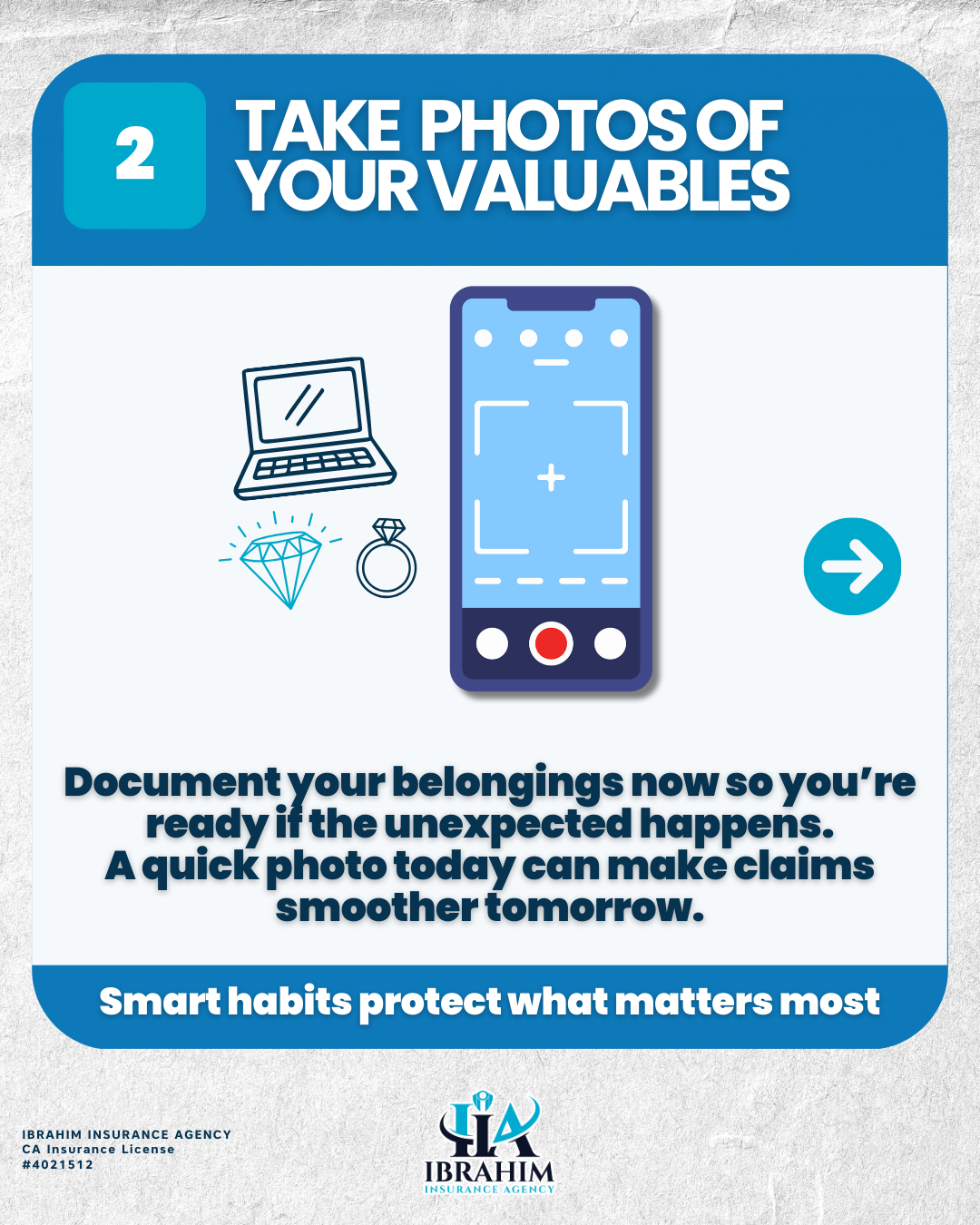
2. Document Your Valuables Before You Need To
If you ever need to file a claim, proof matters. Taking photos or videos of your valuables now can make the claims process much smoother later.
We recommend documenting:
Electronics
Jewelry
Furniture
Appliances
High-value personal items
Store these photos digitally, ideally in cloud storage or emailed to yourself. This simple step can help claims move faster and reduce stress during an already difficult time.
3. Make Sure Your Policy Covers Flood Damage
One of the most common misconceptions we see is flood coverage. Many standard homeowner policies do not automatically include flood insurance.
In California, flooding can happen due to heavy rain, drainage issues, or unexpected weather events, even outside traditional flood zones. If flood coverage matters to you, it’s important to review your policy and understand what is and isn’t included.
Important to Know:
Flood insurance is often a separate policy and must be added intentionally.
4. Protect Your Home Year-Round, Not Just at Renewal Time
Home safety isn’t a one-time checklist, it’s an ongoing habit. Reviewing your coverage annually helps ensure your policy keeps up with changes like renovations, new purchases, or life events.
A quick coverage review can reveal gaps you didn’t know existed and help you adjust protection before something goes wrong.
Want Help Reviewing Your Coverage?
If you’re not sure what your current policy covers, you’re not alone. We help homeowners across California review their coverage, answer questions, and make sure everything is properly protected.
📍 Based in Corona, CA
📲 DM us or call/text 951-256-9648 for a free coverage review
💬 Se habla español

Insurance Isn’t Confusing, It’s Just Never Been Explained Properly
Insurance doesn’t have to be confusing. Most people feel lost because no one has ever explained coverage in a simple, real-world way. This article breaks insurance down so it actually makes sense.
Understanding Insurance the Simple Way in California
If insurance feels confusing, you’re not alone. Most people don’t struggle because insurance is too complicated, they struggle because no one ever took the time to explain it clearly.
At Ibrahim Insurance Agency, we hear this all the time. Clients come in frustrated, unsure what they’re paying for, and worried they might be missing something important. The truth is, insurance makes a lot more sense once it’s explained in plain language.
Why Insurance Feels Complicated
Insurance policies are often written with technical terms and legal language that don’t reflect how people actually live their lives. Instead of focusing on real situations, policies are presented as pages of fine print.
That’s not helpful for the average person who just wants to know:
• Am I covered if something happens?
• What am I actually paying for?
• Will this protect my family, car, or business?
Insurance Is About Real Life Situations
Insurance isn’t about memorizing definitions. It’s about understanding how coverage works when real life happens.
For example:
• What happens if you’re in an accident?
• What happens if your car is stolen?
• What happens if someone gets hurt on your property?
• What happens if your business has to pause unexpectedly?
Once coverage is explained using real scenarios, insurance becomes much easier to understand.
Why Education Matters More Than Price
Many people shop for insurance based on price alone because they don’t fully understand the coverage. While cost matters, the cheapest policy isn’t always the best one.
Understanding what your policy covers, and what it doesn’t, helps you avoid surprises when you need to file a claim. A slightly higher premium can often mean significantly better protection.
A Different Approach to Insurance in California
Our approach is simple:
• Explain coverage clearly
• Answer questions honestly
• Make sure clients understand their options
We believe insurance should feel like a conversation, not a lecture. Whether you’re looking for auto, home, renters, or business insurance, our goal is to make sure you feel informed and confident in your decisions.
When Should You Review Your Insurance?
Insurance isn’t something you set and forget. You should review your coverage if you:
• Buy a new car
• Move to a new home or apartment
• Start or grow a business
• Experience changes in your household
Even small life changes can affect your coverage.
Insurance Doesn’t Have to Be Stressful
When insurance is explained properly, it stops being intimidating. It becomes what it’s meant to be, protection and peace of mind.
If you’ve ever felt confused about your insurance, you’re not alone. Asking questions is the first step toward better coverage.
Local note: As a Corona, CA based agency serving all of California, we’re here to explain insurance in a way that actually makes sense.

New Year, New Goals: Insurance Resolutions That Actually Matter
New year, New Goals: Insurance Resolutions That Actually Matter
Serving Corona, CA and all of California
The start of a new year is when most people reset their priorities. We focus on health goals, financial plans, family time, and personal growth. But there’s one resolution that often gets overlooked and can make a real difference when life doesn’t go as planned: making sure your insurance coverage actually fits your life.
If you live in Corona or anywhere in California, reviewing your insurance should be part of your yearly reset.
Why Insurance Belongs on Your Resolution List
Insurance isn’t something most people think about until they need it. The problem is that by the time something happens, it’s too late to make changes. A yearly insurance review helps ensure you’re not underinsured, overpaying, or missing important coverage.
Life changes quickly. New cars, new homes, growing families, new businesses, or even remote work can all impact your insurance needs.
Common Life Changes That Affect Your Coverage
Many Californians don’t realize their coverage should be updated after certain milestones, such as:
• Buying or selling a car
• Moving into a new home or apartment
• Starting or growing a business
• Working from home
• Major purchases or renovations
If any of these happened in the past year, your policy likely needs a second look.
Why Reviewing Insurance Once a Year Matters
An annual insurance review helps:
• Identify coverage gaps
• Adjust limits to reflect current needs
• Make sure you’re meeting California requirements
• Avoid surprises during a claim
This doesn’t mean starting from scratch. Often it’s just a matter of small adjustments that can bring peace of mind for the entire year.
Make It a Simple Resolution
You don’t need to make insurance complicated. Think of it as a checkup for your protection. A quick conversation can help you understand where you stand and whether your coverage still makes sense.
Local tip: Working with a local insurance agency in Corona, CA means you’re speaking with someone who understands California regulations and real-life risks in your area.